Unlock Your Future with a Global Ph.D. Opportunity

Applications are now open for the VISTEC–University of Bordeaux Double-Degree Ph.D. Program in cutting-edge chemical and materials research. Join an international research environment where innovation in molecularly imprinted metals, electrocatalysis, smart materials, and advanced chemical systems meets global collaboration between Thailand and France.

More info

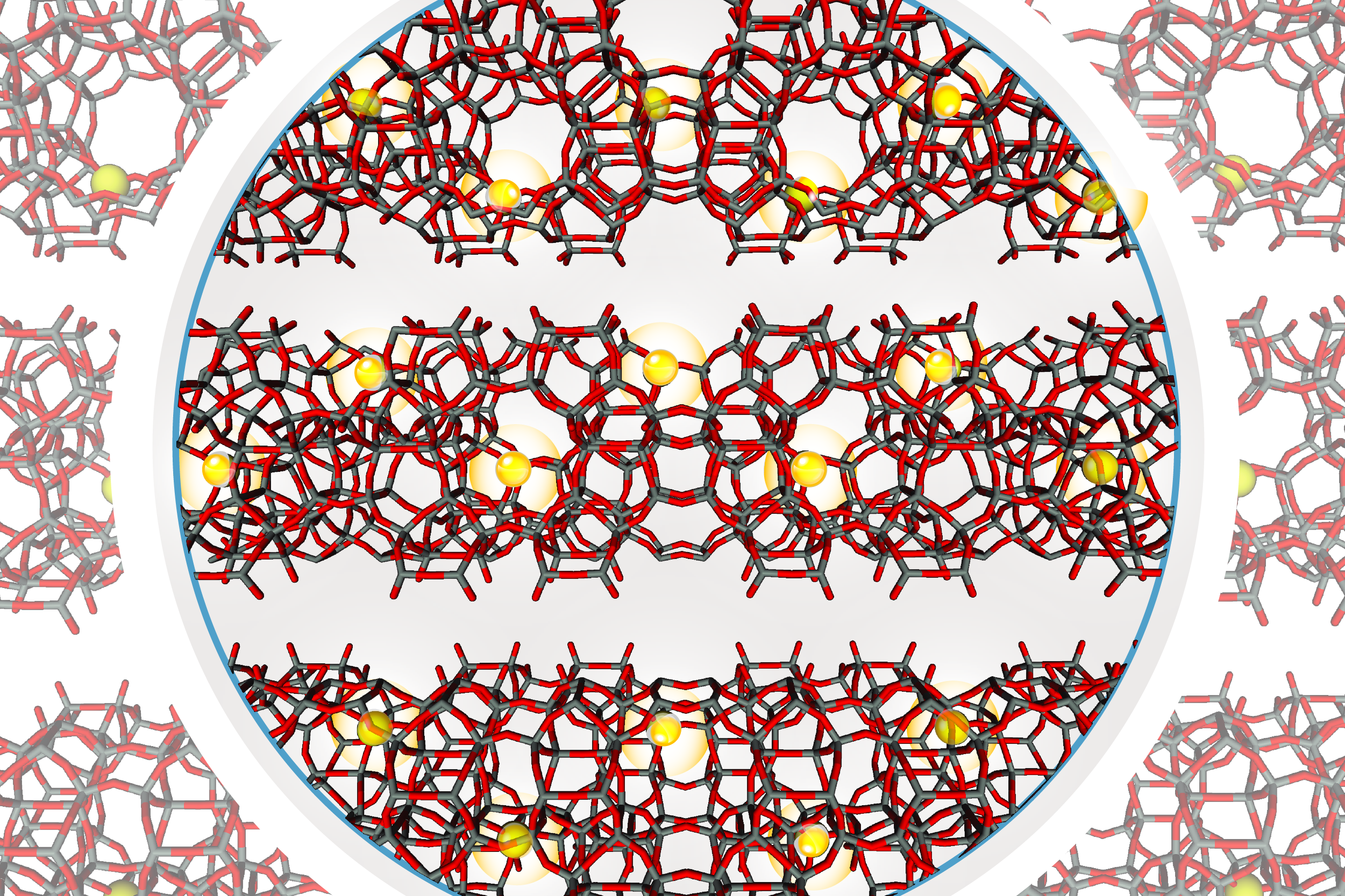
Tailoring the First Coordination Shell of Isolated Ti(IV) Active Sites in Zeolite Frameworks Boosting Catalytic Activity in Epoxidation

We present a strategy to precisely tune the local structure of the tetrahedrally coordinated titanium (Ti) sites incorporated in the zeolite framework via a one-pot hydrothermal synthesis with the aid of NH4F without any further postmodification step.

ChemCatChem2025, 17, e202401862

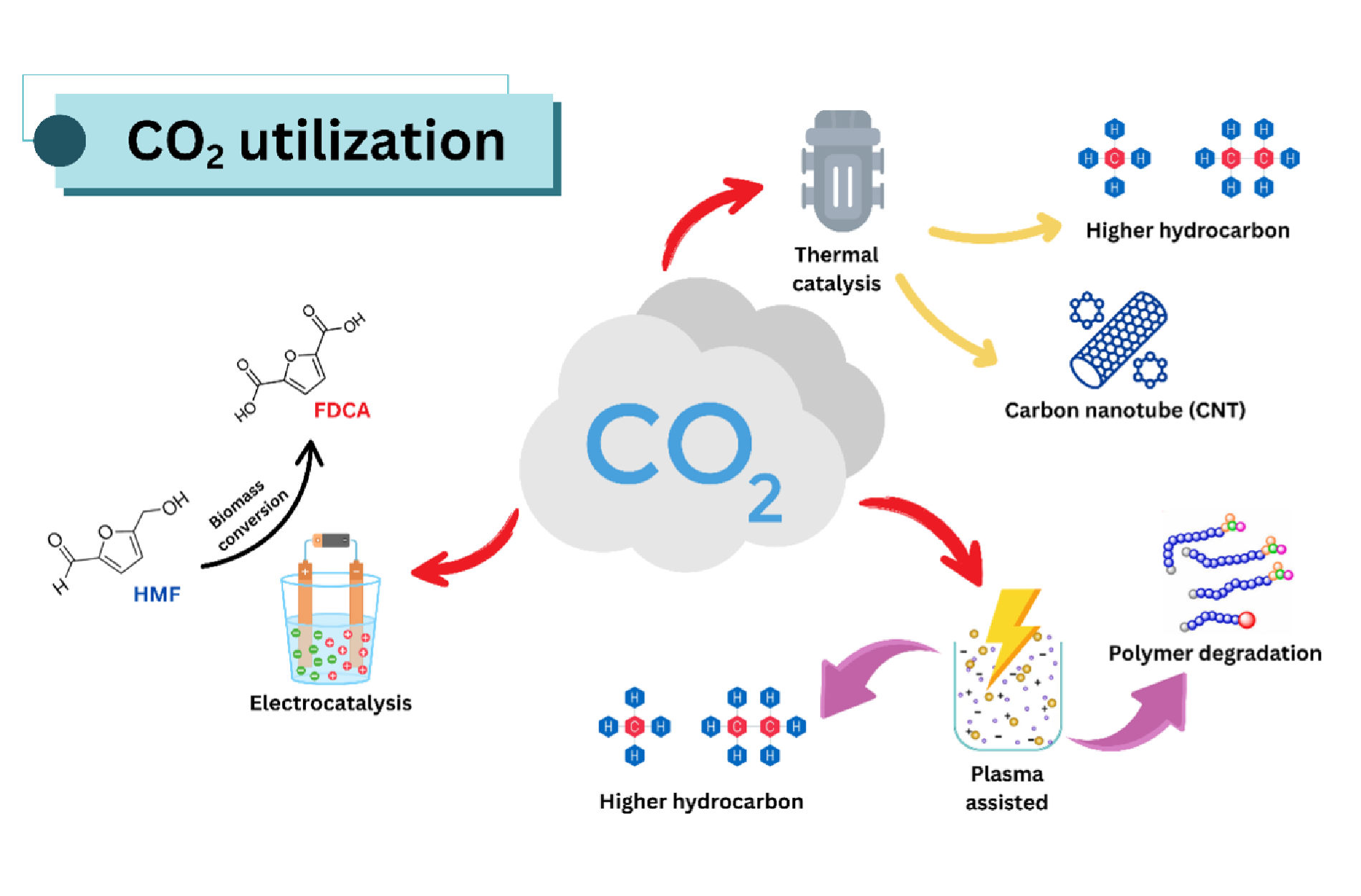
Simultaneous Electrochemical Upgrading of Biomass and CO2 Utilization Using Fe/Ni-Derived Carbon Nanotubes Derived from CO2

Fe/Ni-supported carbon nanotubes derived from carbon dioxide (CO2) are implemented as working electrodes in the featuring cell for both anode and cathode. Therefore, this system has been applied simultaneously for the electrochemical synthesis of 2,5-furandicarboxylic acid from hydroxymethylfurfural and the electroreduction of carbon dioxide (CO2), as reported by Chularat Wattanakit and co-workers in their Research Article.

Angew. Chem. Int. Ed. 2025, e202501404

Engineering ultrafine Cu nanoparticles supported on zeolites via solvent-free inter-zeolite transformation for bioethanol dehydrogenation

Aggregated Cu clusters were redispersed into smaller size from ~7.5 to ~ 2.5 nm during inter-zeolite transformation of FAU into BEA type zeolite. Superior catalytic bioethanol dehydrogenation reaction into acetaldehyde was promoted by redispersed Cu nanoparticle on tranformed BEA zeolite. This work showcase on the sustainable design of catalyst for use in sustainable catalytic process of bioethanol upgrading.

J. Mater. Chem. A, 2026,14, 2120-2135

Unraveling the Electrocatalytic Activity in HMF Oxidation to FDCA by Fine-Tuning the Degree of NiOOH Phase Over Ni Nanoparticles Supported on Graphene Oxide

This work present fine-tuning the degree of NiOOH deposited on graphene oxide for HMF electrooxidation to FDCA by treating electrodes in alkaline solution with positive potential at different durations. Enhancing the portion NiOOH on electrocatalyst surfaces improve: activity stability. In addition, the theoretical study has been applied to understand reaction mechanisms on NiOOH surfaces.

Small., 2024, 20, 2400779

Rational Design of Isolated Tetrahedrally Coordinated Ti(IV) Sites in Zeolite Frameworks for Methyl Oleate Epoxidation

Isolated Ti(TV)-zeolites have been rationally designed. The different aluminium topological densities of various zeolite frameworks lead to the creation of different degrees of vacant sites for hosting Ti(IV) active sites. The more vacancies in the host zeolite structure, the more isolated tetrahedrally coordinated Ti(IV) can be increased, especially in the BEA framework, eventually enhancing the catalytic performance in methyl oleate epoxidation towards methyl-9,10-epoxystearate.

Chem Asian J. 2024, 19, e202400669

Ni-decorated carbon nanotubes (CNTs) derived from ethanol for electrooxidation of furan derivatives featuring H2 production

Ni-decorated carbon nanotubes (CNTs) derived from ethanol for electrooxidation of furan derivatives featuring H2 production. Ni-decorated carbon nanotubes (CNTs) derived from bioethanol utilized in electrochemical processes allowed simultaneous biorefinery upgrade with hydrogen production. This innovative and efficient approach integrates green CNT electrodes for clean energy, encouraging valuable chemical production from furan derivatives.

Chem. Commun., 2024, 60, 12177

Fine-Tuning Texture of Highly Acidic HZSM-5 Zeolite for Efficient Ethanol Dehydration

This work illustrates how different morphologies of highly acidic ZSM-5 zeolite control the product distribution of ethanol dehydration. It is found that very thin nanolayers of this zeolite with a large external surface area and abundant mesopores enhance the ethylene yield up to 95% with a high longevity.

ChemCatChem (2023): e202201387

Isolated Hf-Isomorphously Substituted Zeolites for One-Pot HMF Synthesis from Glucose

This work demonstrates direct conversion of glucose to 5-hydroxymethylfurfural as an essential pathway in biorefineries. Bifunctional hafnium (Hf)-substituted Beta zeolites containing isolated Hf species as Lewis acid sites in the simultaneous presence of fine-tuning Brønsted acid sites, enable superior catalytic activity and stability under mild conditions, evidenced by experimental and computational results.

Advanced Sustainable Systems, 2023, 7(3),

Bifunctional Pt/Au Janus electrocatalysts for simultaneous oxidation/reduction of furfural with bipolar electrochemistry

The one-pot transformation of biomass-derived compounds into high added-value products via simultaneous electrooxidation/reduction has been achieved by combining bipolar electrochemistry with bifunctional Pt/Au Janus electrocatalysts. This synergy allows the production of furfuryl alcohol and furoic acid from furfural as a model starting compound

Chem. Commun., 2022

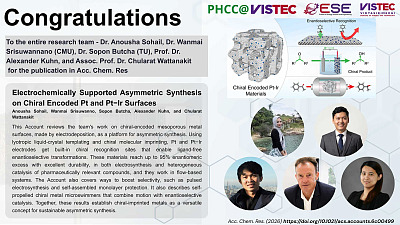
Heterogeneous Enantioselective Catalysis with Chiral Encoded Mesoporous Pt-Ir Films Supported on Ni Foam

Chiral imprinted mesoporous Pt-Ir supported on Ni foam was used to synthesize chiral compounds based on a heterogeneous catalysis approach. Fine-tuning the experimental conditions allows achieving high enantiomeric excess of one stereoisomer.

Chem. Asian J. 2021, 16, 3345.

Nanoengineered chiral Pt-Ir alloys for high-performance enantioselective electrosynthesis

We demonstrate the concept of developing a nanostructured chiral-imprinted metal alloy that not only exhibits very pronounced enantioselectivity, but also has a significantly increased stability when used as an electrode material for the synthesis of chiral molecules.

Nat Commun 12, 1314 (2021)

Synthesis, Characterization, and Electrochemical Applications of Chiral Imprinted Mesoporous Ni Surfaces

In this contribution, we propose mesoporous chiral imprinted nickel as an alternative cheap and earth-abundant metal. The designed surface layers not only demonstrate electrochemical discrimination between two enantiomers, but most importantly also allow stereospecific electroreduction of a prochiral compound, with very significant enantioselectivity of up to 80% ee. These results open up very promising perspectives for the development of low-cost non-noble-metal matrices for the synthesis of chiral compounds.

J. Am. Chem. Soc. 2019, 141, 47, 18870.

PHCC NEWs

Let update PHCC activities

PHCC Research Areas

Our research group mainly focused on these reseach areas:

  • Heterogeneous catalysis
  • Electrosynthesis
  • Porous materials chemistry
  • Carbon dioxide utilization
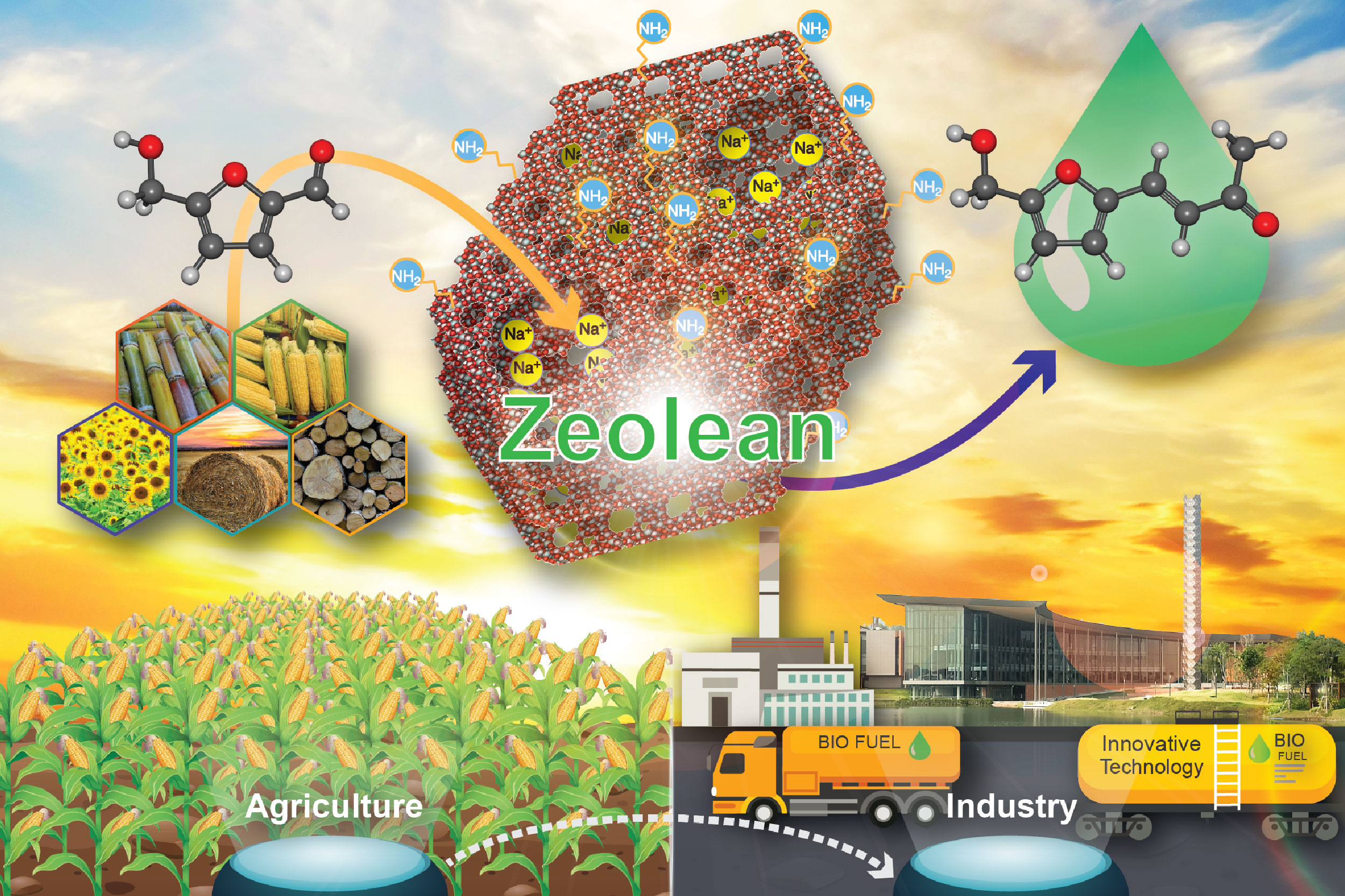
Synthesis of Porous Materials

Hierarchical Zeolites

Image

Renewable Resources

Image

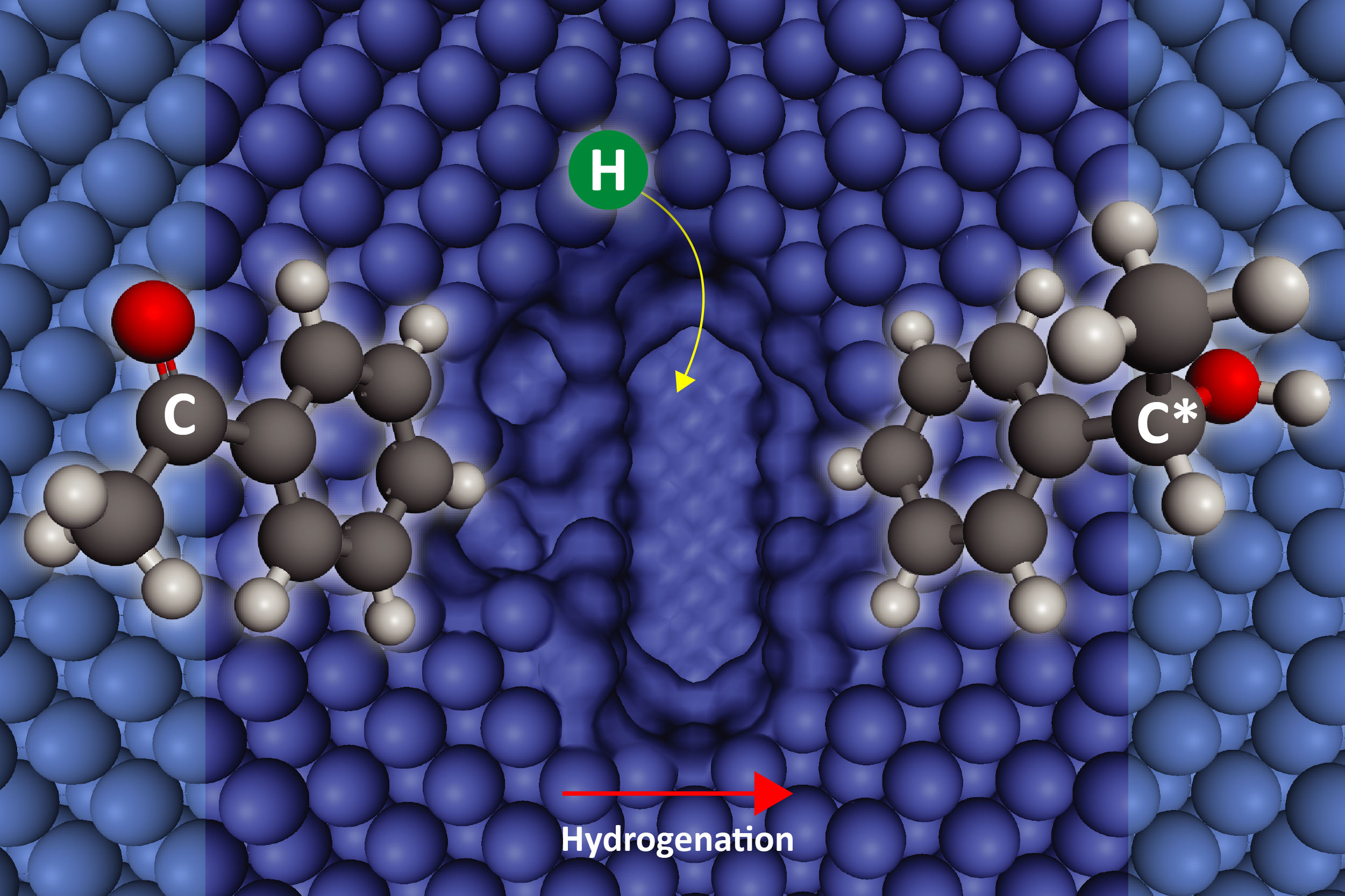
Chiral Compounds

Image

Carbon dioxide utilization

Image

Catalyst design is a business of trust.

We transferred the innovationfrom laboratory to pilot plant scale.into a business model.

International Research Project (IRP)

« ChiraChem »

Principle investigators: 
Prof. Alexander Kuhn / Bordeaux, France Assoc.
Prof. Dr. Chularat Wattanakit / School of Energy Science and Engineering / VISTEC, Thailand

Partners:
Prof. Adrian Flood / School of Energy Science and Engineering / VISTEC, Thailand

The roots
A very fruitful long-term collaboration thatstarted in 2006 with Prof. Jumras Limtrakul and continued in 2015 with Assoc. Prof. Dr. Chularat Wattanakit

POROUS HETEROGENEOUS CATALYSIS CENTER, PHCC

School of Energy Science and Engineering (ESE), VISTEC
Wangchan Valley 555 Moo 1 Payupnai, Wangchan, Rayong 21210 Thailand
Telephone: +66(0) 33 01 4255  
Email: chularat.w@vistec.ac.th

FOLLOW US